How Automated Recruiting Teams Hire 3× Faster With the Same Staff

The hiring industry has embraced digital tools, but not true automation.
Recruiters today use more software than ever before.
LinkedIn, Workable, Bullhorn, Gmail, Calendly, spreadsheets, each handles a slice of the hiring process.
But if you watch a recruiter’s screen for a day, you’ll notice something strange: the work still looks almost the same as it did ten years ago.
Sourcing candidates. Copy-pasting LinkedIn URLs. Writing near-identical outreach messages.
Scheduling interviews through endless email threads.
Updating the ATS by hand.
All of it repeated, every day, for every role.
The problem isn’t that recruiters are inefficient. It’s that the tools around them aren’t connected, and the real automation potential of AI has barely been tapped.
The Silent Time Drain in Modern Recruiting
Hiring has quietly become one of the most fragmented workflows in business.
Each stage, sourcing, outreach, screening, scheduling, sits in a different tool, with a different login, data format, and notification style.
The result? Recruiters spend more time moving information between systems than actually assessing people.
A recruiter might:
- Search profiles on LinkedIn Recruiter
- Copy names into a spreadsheet
- Send outreach from Gmail
- Wait for replies
- Manually add responses to Bullhorn or Workable
By the end of the week, they’ve spent 10+ hours just on admin, the kind of repetitive, low-value work that modern AI agents can now do automatically.
What AI Can Already Handle, Today, Not Tomorrow
Forget the hype about “robots replacing recruiters.”
The real story is quieter, and more practical.
AI agents can now connect the dots between tools you already use.
They don’t replace your ATS or sourcing platforms; they sit between them, orchestrating the process.
Imagine this flow:
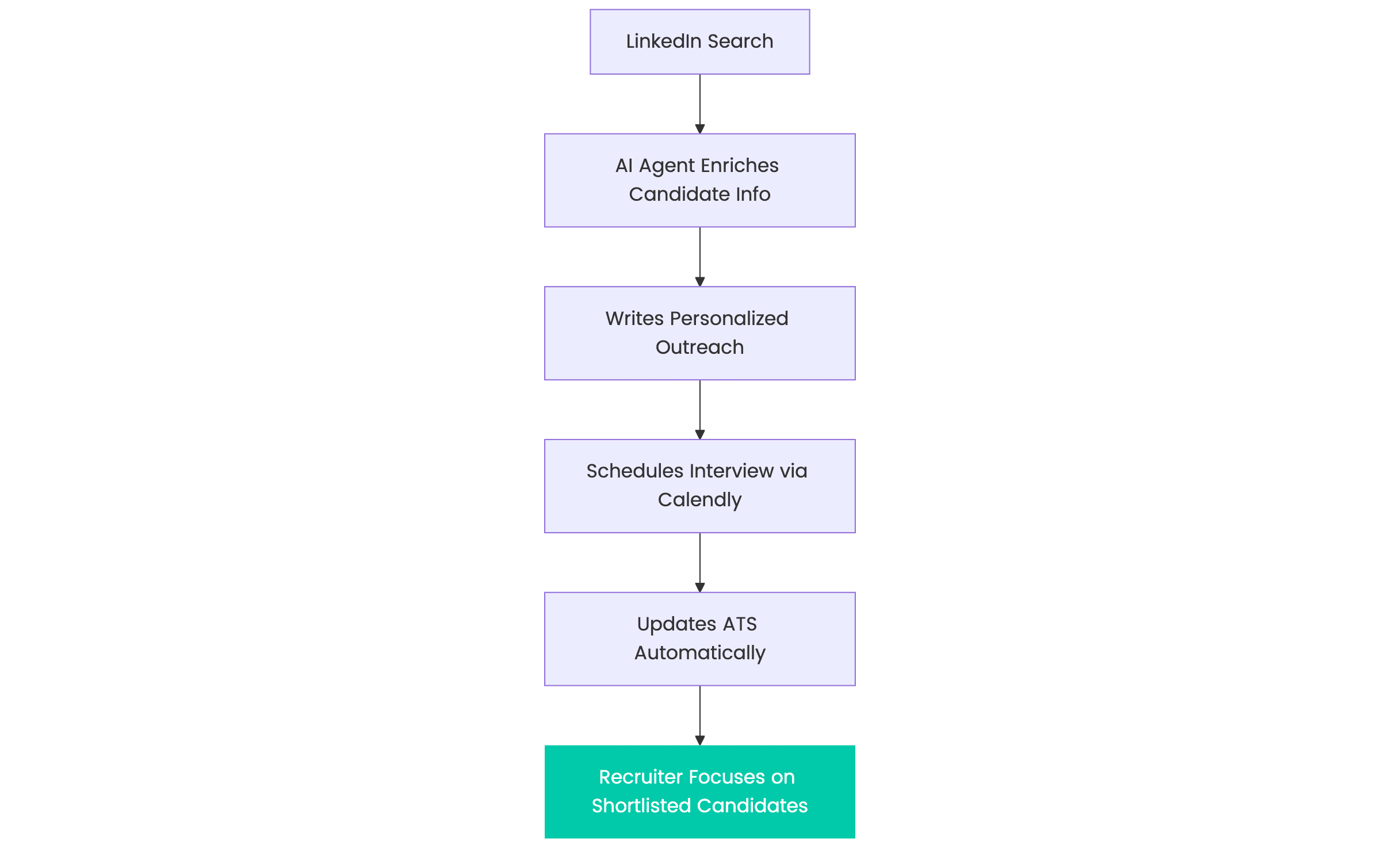
An AI recruitment agent can:
- Pull candidate profiles directly from LinkedIn or job boards
- Cross-check skills and experience against open roles
- Write and send personalized outreach messages
- Manage responses and schedule interviews automatically
- Update CRM or ATS records without human input
Instead of clicking through dozens of screens, recruiters simply review the shortlisted candidates that meet the criteria, ready to engage in real conversations.
Why This Matters Right Now
The recruitment market is under pressure.
Talent shortages are rising, candidate expectations are shifting, and hiring teams are stretched thin.
Speed is now a competitive advantage.
When your competitor replies to a promising candidate 20 minutes faster, you lose that talent, not because your offer is worse, but because your process is slower.
Automation solves that speed gap.
It keeps communication instant, consistent, and personal, without burning out your team.
AI doesn’t skip lunch breaks or forget to follow up. It just works.
Quietly, reliably, behind the scenes.
From Reactive to Predictive Hiring
Manual recruiting is reactive, waiting for candidates, reacting to emails, juggling admin.
Automated recruiting is predictive. It can flag top profiles the moment they fit a new role, send re-engagement messages to past applicants, or remind hiring managers when interviews stall.
That shift, from reacting to predicting, is where the real ROI lies.
Not in replacing recruiters, but in amplifying them.
The New Role of the Recruiter
As AI handles admin, recruiters are free to focus on what humans actually excel at:
- Understanding people’s motivations
- Matching personality and culture
- Persuading talent to take the leap
The recruiter becomes a strategist, not a spreadsheet operator.
A communicator, not a coordinator.
This is where the best talent teams are headed, and they’re already outpacing their competitors.
Why Early Automation Wins
Agencies and in-house teams that start integrating AI agents now are seeing tangible results:
- Faster placements thanks to shorter sourcing cycles
- Lower burnout from reduced admin load
- Higher response rates through personalized outreach
- Improved candidate experience with consistent communication
Automation isn’t futuristic anymore, it’s quietly becoming the new baseline.
The only question is whether you’ll be the team using it or the one competing against it.
Recruiters will always be essential, but their time shouldn’t be wasted on clicks and copy-paste.
Automation isn’t about replacing people; it’s about removing friction.
And when recruiters stop doing what software can do, they finally have time to do what only humans can.
Want to Automate, But Not Sure Where to Start?
If you’re curious what parts of your recruiting process could be automated, or how AI could connect with your existing tools, our team can help you map it out.
👉 Book a free consultation to identify high-impact automations in your workflow and get a practical, ROI-focused roadmap for your team.