AI Interview Scheduling: No More “What Time Works for You?”

Scheduling shouldn’t take longer than the interview itself.
Every recruiter knows this pain:
You’ve found a great candidate, exchanged messages, and then spend two more days trying to find a time that works for everyone.
“How about Wednesday at 2?”
“I can’t. Maybe Thursday morning?”
“Let me check with the hiring manager.”
By the time the slot is confirmed, the candidate has already booked another interview somewhere else.
That’s not bad luck, it’s process friction.
And it’s one of the easiest parts of recruitment to automate.
Why Interview Scheduling Still Feels So Manual
At first glance, scheduling seems simple, but in reality, it’s one of the biggest time-wasters in recruitment.
Between candidates, hiring managers, and interview panels, someone is always waiting for a calendar update or an email reply.
The result is a long chain of small delays that quickly add up.
A typical scenario looks like this:
- The recruiter proposes a few time slots.
- The candidate replies with new preferences.
- The hiring manager’s availability changes again.
- Another round of messages follows.
- Finally, everything gets updated in the calendar and ATS.
Multiply that by twenty candidates in a week, and hours disappear on a task that could be automated with simple workflows.
Where AI Changes the Game
AI scheduling agents don’t just send calendar links.
They manage the conversation like a human assistant, reading messages, detecting availability, and suggesting slots automatically.
Here’s what a modern setup looks like:
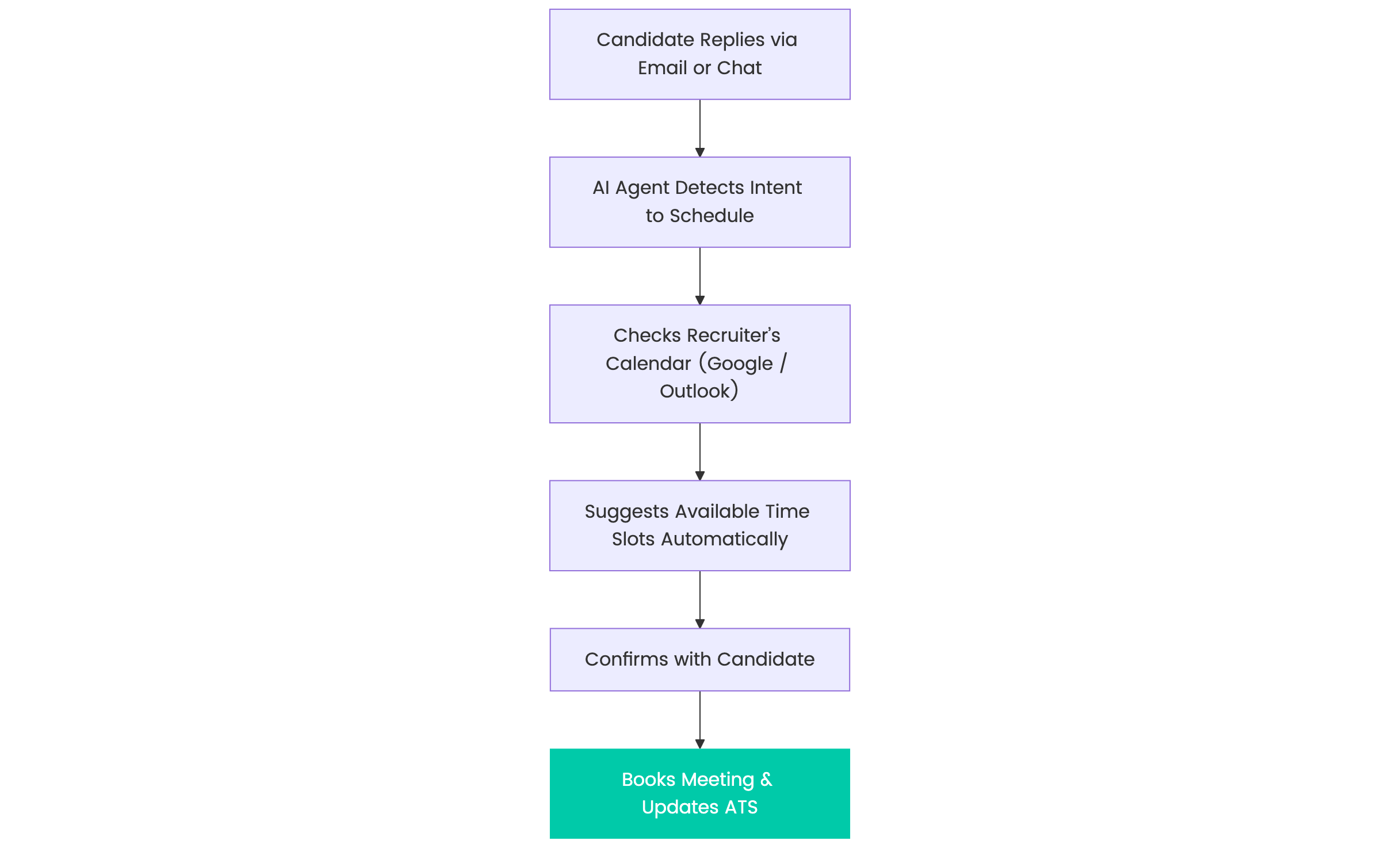
This kind of agent integrates with:
- Google Calendar or Outlook 365
- Calendly or Cronofy APIs
- Your ATS or CRM (e.g., Workable, Lever, Bullhorn)
Once a candidate agrees, the system automatically:
- Creates the event
- Sends invites and reminders
- Updates the ATS with the scheduled slot
- Notifies the recruiter and manager in Slack or email
The result: no friction, no back-and-forth, no forgotten follow-ups.
The Real Impact on Recruiting Teams
For most agencies, interview coordination can take 30–60 minutes per candidate.
With AI scheduling, that drops to under 5 minutes, or zero, if fully automated.
Multiply that across a typical week:
15 candidates × 45 minutes saved = over 11 hours reclaimed.
That’s nearly a day and a half of recruiter time per week, just from automating scheduling.
And it’s not just time. It’s speed to hire.
Faster replies mean fewer lost candidates and a smoother experience for everyone.
What Candidates Notice
Automation done right doesn’t feel robotic, it feels respectful.
Candidates receive:
- Instant confirmation messages
- Calendar invites with all details
- Friendly reminders
- Easy options to reschedule
It’s like having a professional coordinator available 24/7.
That’s what creates a premium experience, not a chatbot, but a responsive, human-like assistant that never forgets a step.
The Recruiter’s New Workflow
Instead of coordinating schedules, recruiters now:
- Focus on preparing for interviews, not booking them
- Get automatic Slack or email alerts when meetings are set
- Review upcoming calls directly in their CRM or ATS dashboard
The system becomes self-updating, no manual calendar management required.
Real Automation in Action
Here’s a simple example:
A candidate replies to your outreach saying they’re interested. Your AI recruiter detects the intent, checks availability, and suggests: “Great to hear! The hiring manager is free Wednesday 2 PM or Thursday 10 AM, what works best?” Once the candidate confirms, it automatically books the slot and updates your CRM.
The recruiter gets a notification, and that’s it.
There’s no manual messaging, no duplicate calendar invites, and no chasing confirmations.
Everything happens automatically in the background.
From “Ping-Pong” to Precision
The phrase “What time works for you?” is the symbol of inefficiency in recruitment.
It represents every repetitive micro-task that slows teams down, and that AI can quietly remove.
Scheduling is just one step. But it’s also the turning point, the moment recruiters realize automation doesn’t mean losing control.
It means losing friction.
Ready to Stop the Scheduling Chaos?
If your team still spends hours coordinating interviews, it’s a clear sign your workflow has too many manual steps, and those can be automated.
At Invra, we help recruitment teams map, design, and implement automation that works with the tools you already use, inbox, calendar, ATS, and messaging platforms.
👉 Book a free consultation and let’s explore where automation could save your recruiters the most time, so they can focus on what really matters: finding and hiring great people.