How We Secure AI Agents Against Bans & Blocks (Proxy & Human-like Behavior)

Why “Smart” Isn’t Enough, AI Agents Must Also Be Safe
Every company experimenting with AI outreach or lead automation eventually hits the same wall: bans, blocks, or account restrictions.
You can have the most advanced AI logic in the world, but if your system behaves like a bot, sending too fast, logging in from one IP, or repeating patterns, it’ll get detected.
That’s why reliable AI agents aren’t just intelligent, they’re disciplined.
Building long-lasting outreach automation means designing systems that behave like humans and distribute risk intelligently.
The Hidden Enemies of Scale
Let’s start with what typically gets outreach systems banned or flagged:
- Velocity spikes, sending 100+ messages per hour from one account.
- Single-origin behavior, all actions coming from the same IP or device fingerprint.
- Perfect repetition, identical delays, text, or click patterns.
- Skipping warm-up, blasting messages from fresh domains or accounts.
- Static headers and fingerprints, making detection trivial for anti-spam systems.
Even a great outreach strategy collapses if the underlying behavior looks robotic.
The Engineering Approach: Staying Invisible
At Invra, we design AI agents that don’t just “send”, they act natural.
Our anti-ban strategy combines proxy diversity, realistic timing, and progressive scaling to mimic real human behavior and keep outreach invisible.
Here’s a simplified view of how that works:
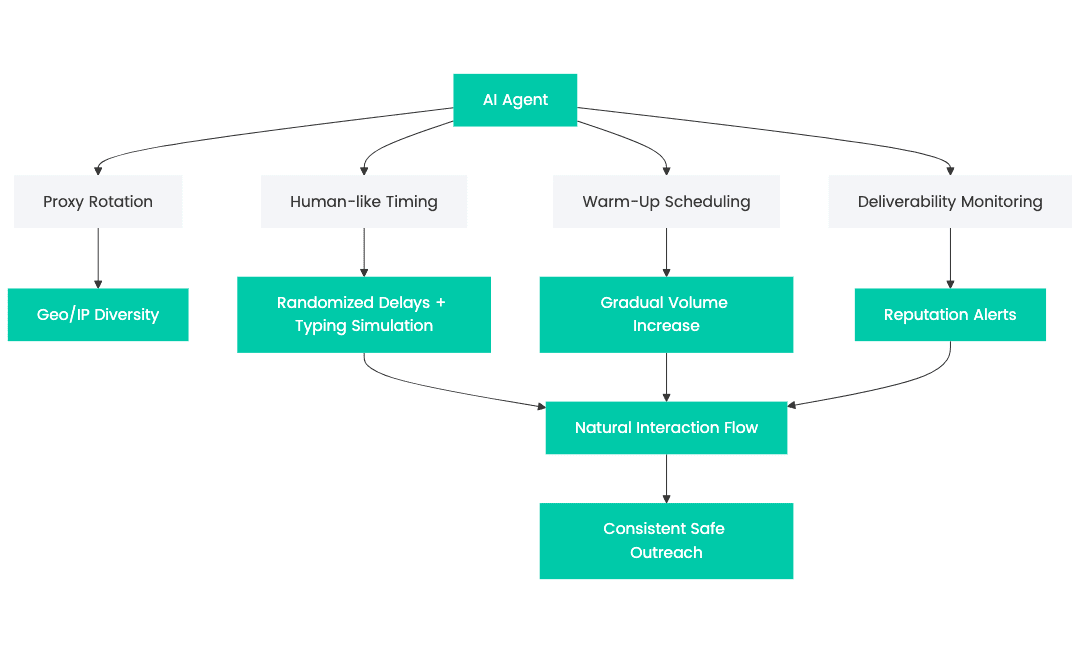
1️⃣ Proxy Rotation & Identity Diversity
Every agent routes activity through a rotating proxy network, so actions don’t all originate from one IP.
- Residential proxies mimic real users, not servers.
- Rotating fingerprints (browser type, OS, time zone) makes traffic unique.
- Geo-matching keeps sender locations realistic, a UK sender looks like they’re in the UK.
This reduces the chance of triggering IP or location-based detection systems.
2️⃣ Human-like Timing & Behavioral Variability
Real people don’t send messages at perfect intervals. Bots do.
Our agents use a behavior simulation that introduces a natural rhythm:
- Randomized message delays (e.g., 47s, 1m12s, 2m05s).
- “Typing” and “thinking” delays on chat platforms.
- Working hours aligned with each prospect’s timezone (8:00–18:00).
The result: communication that looks spontaneous, not mechanical.
3️⃣ Gradual Warm-Up for Accounts & Domains
New sending domains and LinkedIn accounts must build trust before scaling.
| Phase | Duration | Sending Volume | Description |
|---|---|---|---|
| Phase 1 | Days 1–7 | 10–20/day | Low-volume, internal or test messages |
| Phase 2 | Days 8–14 | 25–40/day | Mix of warm emails and replies |
| Phase 3 | Day 15+ | 40–60/day | Normal activity with natural variability |
Gradual volume increases and simulated two-way conversations establish credibility with spam filters and platforms.
4️⃣ Deliverability & Reputation Monitoring
The system continuously tracks how each sender performs, if engagement suddenly drops, something’s wrong.

If an account’s reputation weakens, it’s automatically paused until metrics recover. This proactive rotation prevents permanent bans and maintains deliverability.
5️⃣ Reputation Maintenance
Email and domain reputation are like credit scores, easy to lose, slow to rebuild.
We prevent long-term issues by:
- Monitoring SPF/DKIM records and DNS health.
- Rotating domains before any hit “critical” reputation thresholds.
- Tracking blacklist databases to identify early risks.
This continuous hygiene keeps outreach sustainable and trustworthy.
Why This Engineering Discipline Matters
Automation is easy. Safe automation is hard.
The difference between a short-lived campaign and a scalable outreach operation is discipline, in pacing, rotation, and monitoring.
These engineering principles make AI outreach not just powerful, but sustainable:
- Predictable results → no random bans or downtime.
- Consistent uptime → campaigns run continuously.
- Protects reputation → domains, accounts, and trust stay healthy.
That reliability is what allows SMEs and agencies to automate outreach confidently.
Final Thoughts
AI automation isn’t just about writing messages, it’s about ensuring those messages actually get delivered.
By combining proxy rotation, human-like behavior, warm-up protocols, and deliverability tracking, you can scale outreach safely across channels.
It’s not magic, it’s disciplined engineering.
And it’s what keeps our AI agents active, invisible, and effective over time.
📩 Want to design an outreach setup that scales safely? Book a call with Invra.